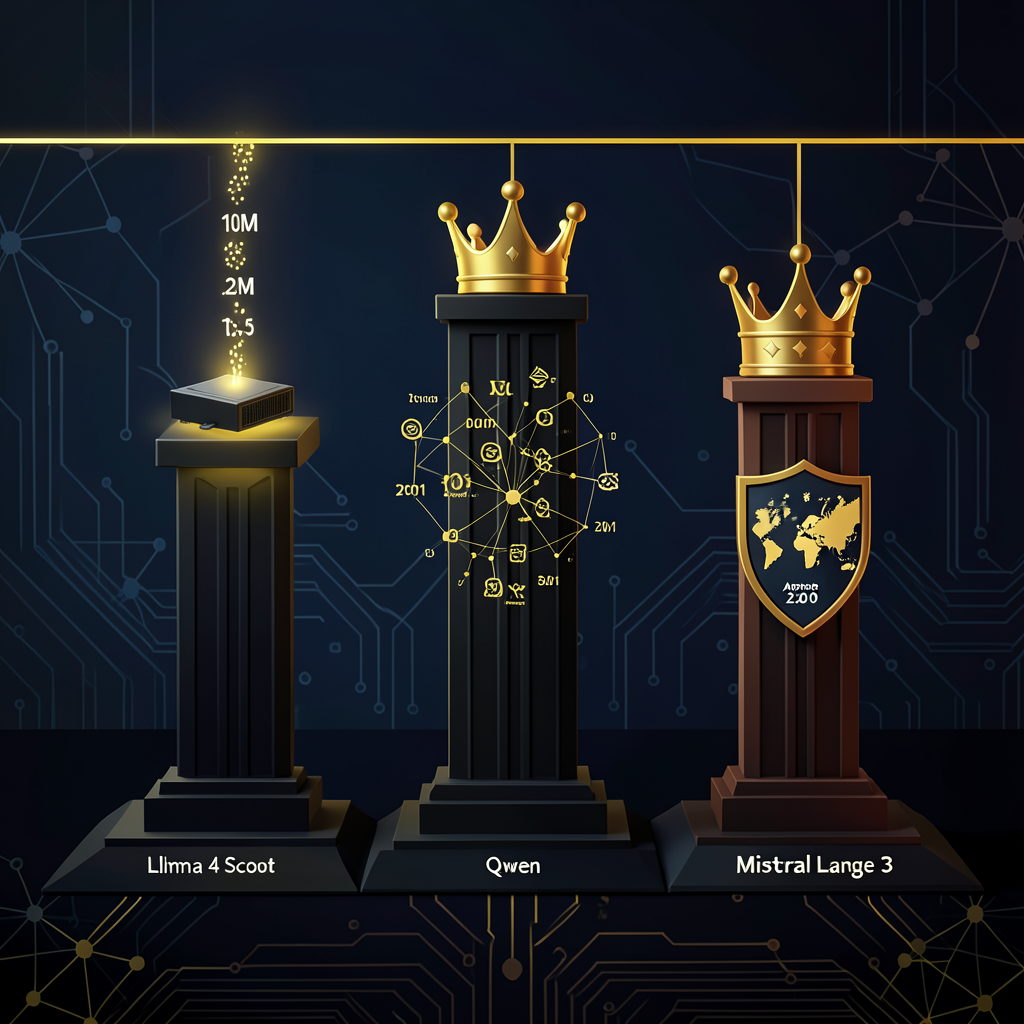
Llama 4 vs Qwen 3.5 vs Mistral Large 3: The Best Open-Weight LLM in July 2026
TL;DR In 2026, open-weight models have closed much of the gap with proprietary APIs, and the three strongest contenders each excel in different areas. Llama 4 Scout delivers the cheapest capable single-GPU deployment at 17B active parameters, Qwen 3.5 leads on multilingual coverage (201 languages), multimodal capability, and Apache 2.0 licensing, while Mistral Large 3 targets EU-privacy-first teams with GDPR-native data residency. No single model wins outright — the right choice depends on your workload, compliance requirements, and hardware budget. TL;DR: Qwen 3.5 is the best open-weight LLM overall for July 2026 — highest coding score (76.4% SWE-bench), strongest reasoning, broadest language coverage, and Apache 2.0. Choose Llama 4 Scout for extreme context at single-GPU cost, Mistral Large 3 for EU compliance. ## The Open-Weight Revolution: Why 2026 Is the Tipping Point Two years ago, “open source” meant accepting a meaningful capability tax. You self-hosted to control data or cut costs, and you paid for it in reasoning quality. That trade-off has largely collapsed. On agentic coding, flagship open-weight models now score in the low-to-mid 70s on SWE-bench Verified, compared with roughly 80% for the very top closed systems (tech-insider.org/llama-4-vs-qwen-vs-mistral-2026). On knowledge and reasoning benchmarks like MMLU and GPQA Diamond, the leading open models are effectively at parity with last generation’s proprietary flagships. The other shift is who is shipping. Meta lit the open-weight fire with Llama, but its cadence has slowed. Llama 4 launched in April 2025 and — as of July 2026 — remains the current generation. Its largest planned member, the roughly two-trillion-parameter “Behemoth” teacher model previewed at launch, has still not shipped publicly and is widely considered shelved (siliconangle.com, May 2025); there is no Llama 5. Into that vacuum stepped Alibaba’s Qwen team and France’s Mistral AI, both iterating on a monthly rhythm. That reversal — a Western incumbent pausing while a Chinese lab and a European startup sprint — is the single biggest reason the open-weight question is genuinely open again (tech-insider.org/llama-4-vs-qwen-vs-mistral-2026). For teams, the stakes are practical. An open-weight model you can run on your own hardware means no per-token bill, no rate limits, no vendor lock-in, and — critically for regulated industries — no customer data leaving your VPC. The question is no longer “open or closed?” but “which open model, on what hardware, under which license?” (tech-insider.org/llama-4-vs-qwen-vs-mistral-2026).
## The Contenders: Architecture, Specs, and Lineup **Meta Llama 4 Scout** carries 109B total parameters with just 17B active across 16 experts. Its headline feature is a 10-million-token context window — the longest of any model in this comparison. Meta positions the Int4-quantized build as single-GPU capable (fits on one H100). Both Llama 4 variants are governed by the Llama 4 Community License, a source-available license with conditions for large-scale commercial use (tech-insider.org/llama-4-vs-qwen-vs-mistral-2026; computingforgeeks.com/open-source-llm-comparison). **Meta Llama 4 Maverick** scales to 400B total parameters, still 17B active but spread across 128 experts. It carries a 1-million-token context window and is positioned as Meta's flagship generalist. Both Scout and Maverick are natively multimodal, accepting text and images as input (computingforgeeks.com/open-source-llm-comparison). **Alibaba Qwen 3.5** rolled out in February 2026 and tops out at a 397B-total / 17B-active MoE model built from 256 experts (8 routed plus 1 shared per token). It ships with a native 262,144-token context window that extends toward roughly one million tokens, native vision-language support, and coverage of 201 languages — the broadest in the industry. The family also includes mid-size 122B-A10B and dense 27B variants for teams wanting simpler serving. Alibaba followed with **Qwen 3.6** in April 2026, including a dense 27B build and a sparse 35B-A3B MoE (only 3B active parameters) tuned for agentic coding. All numbered Qwen releases are open-weight under Apache 2.0 (tech-insider.org/llama-4-vs-qwen-vs-mistral-2026; computingforgeeks.com/open-source-llm-comparison). **Mistral Large 3** answered in December 2025 with a 675B-total / 41B-active MoE model — the largest total parameter count in this trio — under a clean Apache 2.0 license and a 256K context window with text-and-image input across 80-plus languages. In March 2026 Mistral added **Mistral Small 4**, an 119B-total model activating only 6B parameters per token (128 experts, 4 active), also 256K context and multimodal. Mistral's pitch is efficiency, EU data-residency friendliness, and a genuinely permissive license with no MAU cap (tech-insider.org/llama-4-vs-qwen-vs-mistral-2026; computingforgeeks.com/open-source-llm-comparison). ## Benchmark Head-to-Head: Coding, Reasoning, Multilingual, and RAG Benchmarks are where marketing meets measurement. We've pulled figures only where a vendor or independent tracker published them. Llama 4 Maverick owns the highest verified MMLU among these open models at 85.5% — a testament to Meta's pre-training scale. Qwen leads the reasoning-and-math cluster: 77.2% GPQA Diamond and 85.7% AIME '24 are the strongest open scores here. Qwen 3.5 397B posts 76.4% on SWE-bench Verified — within striking distance of the closed frontier, which tops out around 80–81%. Mistral Large 3's standout is its LMArena Elo of roughly 1418, placing it near the top of open-weight non-reasoning chat models (tech-insider.org/llama-4-vs-qwen-vs-mistral-2026; computingforgeeks.com/open-source-llm-comparison). On coding, Qwen is the open-weight coding leader. Qwen 3.5 397B's 76.4% on SWE-bench Verified is the highest of the trio, and the specialized Qwen 3.6-35B-A3B reaches 73.4% while activating only 3B parameters per token — an efficiency-to-capability ratio unmatched for local coding assistants. Mistral Large 3 is a capable coder but does not lead any published coding leaderboard; its strengths lie in instruction-following, tool use, and multilingual generation. Llama 4 notably does not headline the coding conversation — no flagship Llama 4 SWE-bench Verified figure is prominently published (tech-insider.org/llama-4-vs-qwen-vs-mistral-2026). Multilingual coverage is unambiguous: **Qwen 3.5 supports 201 languages**, with top-tier quality in Chinese, Japanese, Korean, Arabic, and other non-European languages. Mistral covers 80-plus languages with strong European-language coverage. Llama 4 officially emphasizes a smaller set of a dozen or so well-supported languages, with English as its center of gravity (tech-insider.org/llama-4-vs-qwen-vs-mistral-2026). On context, Scout's 10M and Maverick's 1M dwarf the 256K that Qwen 3.5 and Mistral offer natively. However, usable context rarely equals advertised context — retrieval accuracy tends to degrade before the theoretical maximum, so most production RAG pipelines still chunk and retrieve rather than dumping everything into one prompt (tech-insider.org/llama-4-vs-qwen-vs-mistral-2026). Qwen's 262K native context with vision-language support is the practical RAG choice for most teams. All three flagships accept text and images natively as of July 2026 (computingforgeeks.com/open-source-llm-comparison). ## Pricing and Hardware: Hosted API Costs vs Self-Hosted TCO Open weights change the pricing conversation entirely. The model license itself costs nothing for all three families, so the real cost is either (a) the GPUs you run them on if you self-host, or (b) the per-token rate a managed provider charges. Representative managed-inference rates from 2026: Llama 4 Maverick at approximately $0.27 input / $0.85 output undercuts most closed models by an order of magnitude; Mistral Large 3 at $0.50/$1.50 is priced well below comparable proprietary flagships (tech-insider.org/llama-4-vs-qwen-vs-mistral-2026). Managed open-weight inference is dramatically cheaper than proprietary frontier APIs. Self-hosting flips the economics at scale. Once your monthly token volume is high enough to saturate a GPU fleet, the amortized cost per token on your own hardware can fall below any managed rate, and you gain full data control. A 17B-active MoE at scale can cost orders of magnitude less than per-token API pricing. Scout's Int4 quant on a single H100 is the cheapest entry point for single-GPU deployment. Maverick and Qwen's flagship require multi-GPU setups — hardware costs scale with expert count (computingforgeeks.com/open-source-llm-comparison). Apache 2.0 models (Qwen, Mistral) tend to have the most competitive third-party pricing because providers face no licensing friction. Mistral follows a tiered pricing model by size, with EU-hosted options at a premium. Real deployment TCO must include GPU amortization, inference optimization (vLLM, SGLang, quantization), and token consumption per task (tech-insider.org/llama-4-vs-qwen-vs-mistral-2026; computingforgeeks.com/open-source-llm-comparison). ## Licensing Deep Dive: The Fine Print That Trips Up Teams This is the section that quietly decides many enterprise procurements, and it is where the three families genuinely diverge. **Qwen and Mistral** release their open-weight models under the **Apache 2.0 license** — a true, permissive open-source license (OSI-approved) that allows commercial use, modification, redistribution, and fine-tuning with essentially no strings attached and no user-count ceiling. For a startup that wants to fine-tune a model, embed it in a product, and never think about the license again, Apache 2.0 is the gold standard. Both Qwen 3.5/3.6 and Mistral Large 3/Small 4 ship under Apache 2.0 (tech-insider.org/llama-4-vs-qwen-vs-mistral-2026; computingforgeeks.com/open-source-llm-comparison). **Llama 4** is different. It ships under the **Llama 4 Community License**, which is source-available rather than open-source by the OSI definition. It permits broad commercial use but with conditions: notably an acceptable-use policy and a clause historically requiring a separate license for products at very large monthly-active-user scale (the 700-million-MAU threshold from prior Llama licenses). For the overwhelming majority of teams this never binds, but legal departments at large platforms do read it carefully (tech-insider.org/llama-4-vs-qwen-vs-mistral-2026). There is also an important EU-specific restriction: the Llama 4 Acceptable Use Policy explicitly excludes multimodal model rights for individuals or companies based in the EU. Since all Llama 4 models are natively multimodal, this effectively restricts the entire Llama 4 family in the EU — likely a preemptive response to the EU AI Act's transparency and training data disclosure requirements (computingforgeeks.com/open-source-llm-comparison). The takeaway: if licensing purity is a hard requirement — because you are redistributing weights, building a platform at massive scale, or simply want to avoid legal review — Qwen and Mistral's Apache 2.0 gives them a clean edge over Llama 4 on that axis alone. For regulated industries and commercial SaaS, Apache 2.0 offers the cleanest path (tech-insider.org/llama-4-vs-qwen-vs-mistral-2026; computingforgeeks.com/open-source-llm-comparison). ## Five Deployment Scenarios: Which Model Wins Where Benchmarks are abstractions; deployments are concrete. Here are five common scenarios and the model we'd reach for first in each. **Agentic coding.** For multi-step planning, function calling, and iterative test-and-fix workflows, start with **Qwen**. Qwen 3.5 397B scores 76.4% on SWE-bench Verified — the highest of the trio — and Qwen 3.6-35B-A3B reaches 73.4% while activating only 3B parameters. The Qwen3-Coder variants give teams a permissively licensed alternative to closed coding models. For a local coding assistant on a single GPU, Qwen's 3B-active models are unmatched in efficiency (tech-insider.org/llama-4-vs-qwen-vs-mistral-2026). **Multilingual pipelines.** **Qwen 3.5** is the clear leader with 201-language coverage and vision support. For any application targeting East Asian or Middle Eastern markets, Qwen is the default open-weight choice and it is not close (tech-insider.org/llama-4-vs-qwen-vs-mistral-2026). **RAG-heavy workflows.** Qwen's 262K native context with vision is more practical than Llama's 10M for most real use cases. While Scout's extreme context is impressive, usable accuracy degrades well before the maximum, and most production RAG pipelines still chunk and retrieve. Qwen's native context length, combined with vision-language support, makes it the practical choice for document-heavy RAG (tech-insider.org/llama-4-vs-qwen-vs-mistral-2026). **Regulated/EU industries.** **Mistral Large 3 or Small 4** are the natural fit — EU data-residency options, Apache 2.0 licensing, no MAU cap, and strong European-language coverage. Mistral's EU home base and compliance-friendly licensing remove friction that can slow enterprise projects (tech-insider.org/llama-4-vs-qwen-vs-mistral-2026). **Cost-sensitive single-GPU.** **Llama 4 Scout** with Int4 quant is the cheapest capable entry point. Meta positions it as the single-GPU workhorse — a rare combination of 10M context reach and single-GPU deployability. For teams on a tight budget who need serious context, Scout is hard to beat (computingforgeeks.com/open-source-llm-comparison). A sixth pattern worth naming: cost-sensitive, latency-critical inference at scale. Mistral Small 4 (6B active) and Qwen 3.6-35B-A3B (3B active) are the efficiency champions — minimizing GPU spend per request while staying competitive on quality (tech-insider.org/llama-4-vs-qwen-vs-mistral-2026). ## Bottom Line: The Migration Away from Proprietary APIs Is Accelerating The meta-story is the one that matters most for planning: in 2026 the best open-weight LLM is no longer a compromise. Whichever of these three you pick, you get frontier-adjacent quality, full data control, no per-seat lock-in, and — with Qwen and Mistral — a license that lets you build without asking permission. That is a profoundly different world from the one Llama first opened (tech-insider.org/llama-4-vs-qwen-vs-mistral-2026). There is no single universal winner, but there is a clear leader on the metrics most teams weight most heavily. On balance, **Qwen 3.5 is the best open-weight LLM overall for July 2026**: it tops this comparison on coding (76.4% SWE-bench Verified) and reasoning (77.2% GPQA Diamond, 85.7% AIME), offers the broadest multilingual coverage (201 languages), ships under Apache 2.0, and spans a size ladder from 3B-active local models to a 397B flagship. For the largest share of engineering workloads — agentic coding, multilingual assistants, cost-efficient local inference — it is the model to beat (tech-insider.org/llama-4-vs-qwen-vs-mistral-2026; computingforgeeks.com/open-source-llm-comparison). That said, the right answer bends to your use case. Choose **Llama 4 Scout** when context length is the whole game — its 10M-token window and single-GPU deployability are unique. Choose **Llama 4 Maverick** as a flagship generalist if budget allows, though note the source-available license and the fact that the Behemoth variant has not shipped. Choose **Mistral Large 3 or Small 4** when European compliance, Apache-clean licensing, and efficient enterprise deployment matter more than topping a leaderboard; Small 4's 6B-active efficiency is genuinely class-leading (tech-insider.org/llama-4-vs-qwen-vs-mistral-2026). The open-weight question is genuinely open again — and the pace of iteration means today's pick could be tomorrow's legacy. Teams are actively migrating off proprietary APIs in mid-2026 as the quality gap narrows and regulatory pressure mounts. With Qwen iterating monthly, Mistral pushing Apache 2.0 across its entire family, and Llama's ecosystem depth still unmatched, the competition between these families is accelerating the shift away from vendor lock-in (tech-insider.org/llama-4-vs-qwen-vs-mistral-2026). ## Methodology - **Data checked:** 2026-07-09
- **Sources consulted:** [tech-insider.org/llama-4-vs-qwen-vs-mistral-2026](https://tech-insider.org/llama-4-vs-qwen-vs-mistral-2026), [computingforgeeks.com/open-source-llm-comparison](https://computingforgeeks.com/open-source-llm-comparison)
- **Assumptions:** Benchmark figures reflect published vendor or independent tracker data as of July 2026. Managed inference rates are representative from 2026 and may vary by provider.
- **Limitations:** This guide does not cover proprietary API models, fine-tuning methodologies, or model-specific deployment tutorials. Benchmarks are single snapshots and may not reflect real-world performance.
- **Jurisdiction:** Global. ## Source list - Tech Insider — [llama-4-vs-qwen-vs-mistral-2026](https://tech-insider.org/llama-4-vs-qwen-vs-mistral-2026) (accessed 2026-07-09)
- Computing For Geeks — [open-source-llm-comparison](https://computingforgeeks.com/open-source-llm-comparison) (accessed 2026-07-09)
- Meta AI — [The Llama 4 herd](https://ai.meta.com/blog/llama-4-multimodal-intelligence/) (accessed 2026-07-09)
- apxml.com — [Llama 4 Scout specifications](https://apxml.com/models/llama-4-scout) (accessed 2026-07-09)
- **Last substantive check:** 2026-07-09
- **Corrections policy:** If you spot an error, contact us via the [Contact](/contact/) page
- **Affiliation:** theLLMs has no vendor affiliation, sponsorship, or commercial relationship with any AI provider mentioned ## Related guides - [GPT-5.6 Public Launch: Sol, Terra, Luna Family](../gpt-5-6-public-launch-sol-terra-luna-family/)
- [Claude Sonnet 5 vs Opus 4: Agentic Pricing Guide](../claude-sonnet-5-vs-opus-4-agentic-pricing/)
- [OptiLLM Inference Proxy Guide](../optillm-inference-proxy-guide/)
- [GPT-5.6 vs Claude Sonnet 5: Benchmarks and Pricing](../gpt-5-6-vs-claude-sonnet-5-benchmarks-pricing/) ## Change log - 2026-07-09: first published