
TurboQuant and the New Economics of Long-Context Inference
Google's TurboQuant compresses KV caches to 3 bits with zero accuracy loss, enabling 6x memory savings and 4x faster lon
Published now
Google's TurboQuant compresses KV caches to 3 bits with zero accuracy loss, enabling 6x memory savings and 4x faster lon

Why cheapest per-token is rarely cheapest in practice a practical guide to input-output pricing, prompt caching, batch d
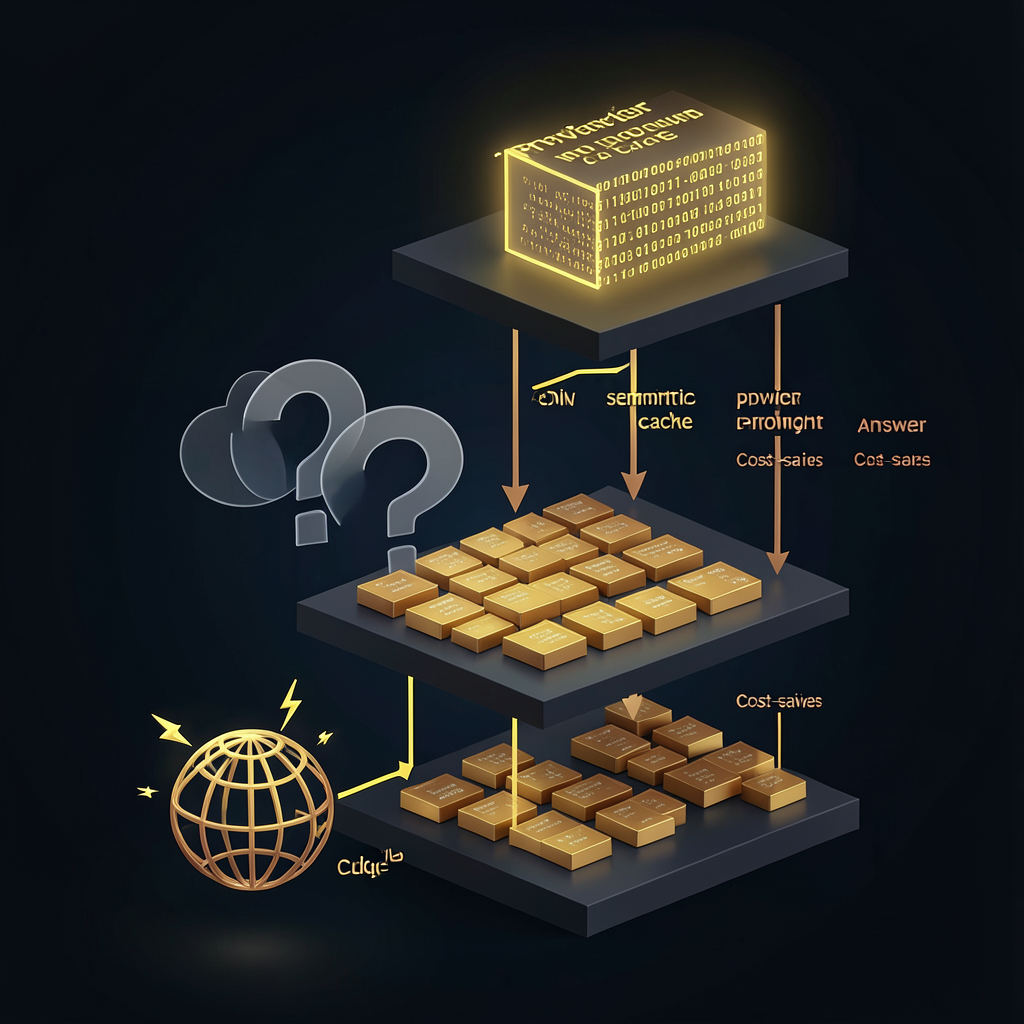
How provider prompt caching, application-level answer caching, semantic caching, and CDN caching layer together for LLM

A plain-English guide to context windows, long-context trade-offs, and when retrieval or chunking beats stuffing everyth

Should you use managed hosted APIs or deploy open-weight models? The choice involves trade-offs in control, privacy, cos

The gap between a polished agent demo and production reliability is measured in tool-use failures. Covers primary failur

Tokens are the fundamental currency of LLM computation. Understanding how they work — and why they fluctuate — is critic

A practical decision checklist to navigate prompting, RAG, and fine-tuning for LLM adaptation, covering cost, latency, f

An analysis of ethical pressure points in the development and deployment of Large Language Models.

A comprehensive examination of operational ethics when deploying LLMs, covering data privacy, hallucination mitigation,
Break-even analysis for custom (self-hosted) vs provider API fine-tuning against prompting and RAG alternatives, coverin

When to cache AI-generated answers to cut costs and latency, when caching risks serving stale or private responses, and

Quick-reference to 18 major LLM benchmarks: what each measures, what it misses, real-world correlation ratings, and how

Estimating cents-per-query for summarisation, RAG, and batch classification with formulas and provider costs across GPT-

A per-token comparison of LLM API providers covering hidden costs, cache economics, and context-window pricing cliffs.

A practical guide to what JSON mode and structured outputs really guarantee, where schema validation still fails, and wh

Why output tokens cost 3-4x more than input tokens and how to get shorter answers without hurting usefulness.

A plain-English explanation of model parameter counts, what 7B, 70B and MoE labels actually tell you, and why bigger num

Why real LLM bills exceed estimates — and how malformed JSON, safety refusals and tool failures multiply API calls.

A practical guide to API quotas, request caps and token limits, and how to plan fallbacks before an AI feature goes live

A practical guide to testing retrieval-augmented generation, spotting whether the retriever or the generator failed, and

A practical breakdown of RAG costs beyond LLM tokens: embeddings, vector storage, reranking, retrieval, generation, and

Learn how prompt caching reduces latency and costs for LLM APIs by reusing processed prefixes in repeated contexts.

A plain-English guide to multimodal AI models: how they combine text, images, audio and video, what each modality costs,

How to route LLM requests across cheap and expensive models using classifier gates, fallback criteria and shadow testing

Why needle-in-haystack success is not the same as synthesis over documents, and how to evaluate long-context models with

A reader-facing comparison of a small local Qwen2.5 7B quantized model and a frontier model writing the same practical L

A plain-English guide to what lm-eval-harness does, why teams use it, and why a benchmark runner is not the same thing a

How to budget for monitoring AI systems — retention, redaction, sampling and the hidden cost of knowing what your models

Understand what function-calling benchmarks actually measure, why leaderboard rankings do not predict production reliabi

What embeddings are, how they turn text into searchable numeric fingerprints, and what to check before buying a vector d

Turn model choice into a repeatable, evidence-led decision with a practical scorecard that measures quality, cost, laten

Learn which LLM leaderboards matter for procurement, how to read rank gaps without being misled, and when to run your ow

Learn when batch APIs can cut your LLM costs by 50%, which providers offer them, and how to design batch-first pipelines

Learn to calculate AI feature costs per user, per task and per successful outcome — including hidden costs from retries,

Build a lightweight LLM cost calculator with dated prices, clear assumptions and scenario inputs — no hidden formulas, n

A guide to LLM parameters: what temperature and top-p control, how deterministic vs creative outputs work, and practical

A plain-English guide to the prompt hierarchy in LLM apps: what system, developer and user roles mean, how instructions

How prompt and output token counts drive LLM billing, and why verbose system prompts, retrieval context, and conversatio